
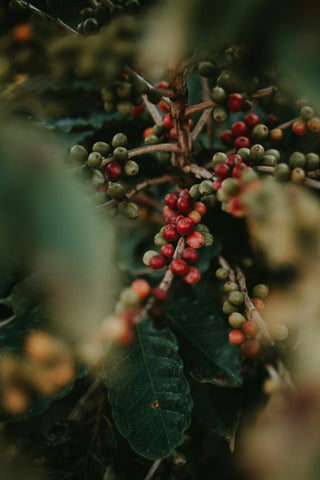
As more drinkers look to decrease their caffeine consumption, naturally low-caffeine coffee species and cultivars offer an alternative to decaffeinated coffee.
At Do Coffee Roasters, we’re passionate about exploring these botanical outliers. This guide explains what low-caffeine coffee is and highlights the key species and hybrids that naturally contain less caffeine than typical arabica or robusta varieties.
What Is Low-Caffeine Coffee?
Low-caffeine coffee refers to coffee produced from plant species or cultivars that naturally contain significantly less caffeine than traditional Coffea arabica or Coffea canephora (robusta). Instead of removing caffeine through processing, these plants biologically produce less caffeine.
Typical caffeine content:
- Arabica: ~1.2–1.7% caffeine
- Robusta: ~2.2–2.7% caffeine
- Low-caffeine species/cultivars: ~0.2–1.1% caffeine (depending on species)
These coffees offer a naturally smooth, sweet, low-bitterness profile.
1. Laurina (Bourbon Pointu)
Scientific classification: Coffea arabica var. laurina
Approx. caffeine: ~0.2–0.6%
Origin: Réunion Island (Indian Ocean)
Laurina is a rare dwarf mutation of the Bourbon lineage, notable for its elongated, pointy seeds—hence the name Bourbon Pointu. It is thought that the Bourbon variety was brought to Réunion Island from Yemen, where it mutated into Bourbon Pointu/Laurina. Laurina typically has the lowest amount of caffeine of the all species or cultivar.
Cup profile
Expect bright acidity, high clarity, and refined sweetness. Strawberry, white peach, rose, and cane sugar are common descriptors.
2. Coffea Eugenioides
Scientific classification: Coffea eugenioides
Approx. caffeine: ~0.3–0.4%
Origin: East Africa
In addition to having a low-caffeine content, Eugenioides is believed to be one of the parent species of arabica - the other parent being Robusta. Eugenioides contributed lower caffeine and a gentler, less bitter flavour profile to arabica. Coffee as we know it wouldn't exist without Eugenioides.
In 2021, Eugenioides rose to prominence when three competitors used it in the World Barista Championship, including the eventual winner, Diego Campos.
C. eugenioides is is indigenous to East Africa; coffee-growing countries like Rwanda, Tanzania, Uganda, Kenya, and the Democratic Republic of Congo. As far as I am aware, only the Finca Inmaculada farm in Colombia grows Eugeniodes for commercial production. I hope to offer Eugenioides to my customers one day, but it is extremely rare and extremely expensive.
Cup profile
The taste profile of Eugenioides is very unique - and some might describe it as polarising. Most notable is its very high sweetness and low-bitterness.
- Lemon drops
- Floral notes like jasmine or lavender
- Melon or payaya fruitiness
- Stevia-like sweetness
3. Coffea Racemosa
Scientific classification: Coffea racemosa
Approx. caffeine: ~0.4–0.7%
Origin: Coastal Mozambique, South Africa and Eswatini
Racemosa is receiving increasing attention for its drought tolerance and ability to grow in harsher climates. The only Racemosa I have seen for sale came from South Africa.
Cup profile
Flavours are often delicate and tea-like:
- Chamomile
- Citrus peel
- Light florals
- Subtle sweetness
4. Aramosa (Hybrid of Arabica × Racemosa)
Scientific classification: Hybrid: C. arabica × C. racemosa
Approx. caffeine: Typically 0.7–0.8%
Origin: Brazil (developed by IAC research programs)
Aramosa was created to combine the refined flavour of arabica with the naturally low caffeine of Racemosa - the name comes from the combination of Arabica Racemosa. Because it is a hybrid of Racemosa and Arabica, it contains more caffeine than Racemosa, but unlike Racemosa, it is one of the most commercially promising low-caffeine hybrid varieties.
Cup profile
Aramosa tends to express:
- Honey
- Orange blossom
- Stone fruit
- Clean, light structure
5. Excelsa
Scientific classification: Coffea Liberica var. Dewevrei
Approx. caffeine: Typically 0.86–1.13%
Origin: Central Africa
Excelsa is a variety of Liberica known for its ability to tolerate high temperatures and low rainfall, making it a valuable variety in a changing climate. Liberica is slightly lower in caffeine than arabica (arabica's caffeine content 1.2-1.7%, Liberica 1.0-1.4%) and the Excelsa variety is lower again at 0.86-1.13%.
Cup profile
- Tart
- Fruity
- Full-bodied
Low-Caffeine Coffee at Do Coffee Roasters
At Do Coffee Roasters, we like to showcase low-caffeine varieties when available. These coffees are very rare and produced in very small quantities. This also means that they tend to be more expensive than typical arabica varieties.